Mobile DRAM Contract Prices Continue Rising in 2Q26, Pressuring Smartphone Production, Says TrendForce
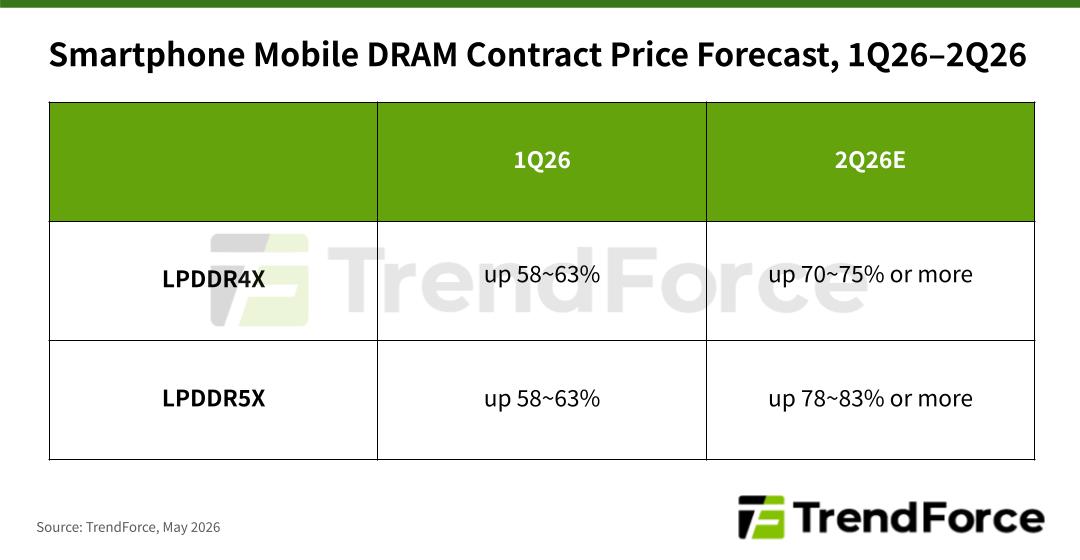
Surging mobile DRAM contract prices in 2Q26 continue to place even greater cost pressure on smartphone brands, according to TrendForce’s latest memory market research. The two major Korean suppliers may have adopted different pricing strategies: Samsung Electronics is pursuing a more aggressive one-step pricing approach with sharper increases, while preliminary quotations from SK hynix indicate relatively milder hikes through a gradual price-raising strategy, with final pricing expected to be completed in late May. Overall, TrendForce estimates that the ASP of LPDDR4X solutions will jump by at least 70-75% QoQ for 2Q26, while the ASP of LPDDR5X solutions will see a QoQ surge of 78-83%.
Notably, several consecutive quarters of steep price increases have significantly intensified cost burdens for smartphone vendors. Under such conditions, brands are expected not only to reduce total smartphone production in 2026, but may also struggle to fulfill the bit procurement volumes stipulated in the LTAs (or MoUs) arranged with suppliers at the end of last year.
High-price environment reshapes smartphone DRAM configurations, limiting high-capacity options
Persistently elevated DRAM prices are forcing smartphone makers to readjust memory configurations across product tiers. In the high-end segment, 12GB is becoming the mainstream configuration while 16GB adoption declines. Meanwhile, mid-range devices are reverting to 8GB as the core specification, and entry-level models mostly settle around 4GB.
Average smartphone DRAM capacity is still projected to increase to 8.5GB in 2026—representing annual growth of 10%—despite the gradual phase-out of 2GB and 3GB models and reduced production of low-spec devices.
This supplier-driven memory price surge will continue exerting deep and sustained pressure on the global smartphone industry over the coming quarters.
TrendForce notes that smartphone brands are being forced to adopt more aggressive countermeasures, including working with app developers to reduce memory consumption and expanding service models that rely more heavily on cloud resources. Only by optimizing software and system architecture in parallel can vendors maintain operational resilience and competitiveness amid mounting cost pressures and slowing demand.